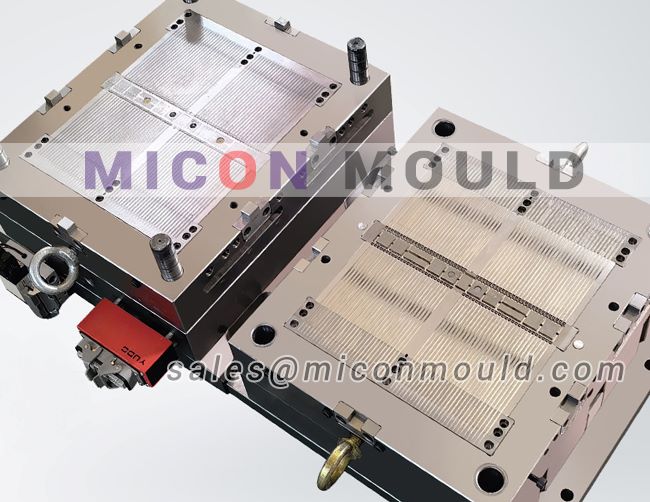
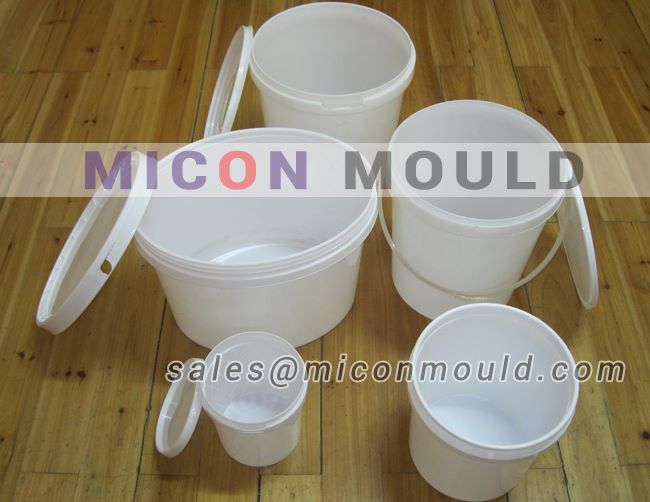
Why make an insert on top of the paint bucket mold core?
In the design and manufacturing of paint bucket molds, the use of inserts on the top of the core is a common and crucial process design. This structural arrangement is not accidental, but rather an optimized choice after comprehensively considering factors such as processing difficulty, maintenance costs, and product quality. As a professional mold company, Micon Mould also widely adopts this technology in paint bucket mold design, and the following analysis explains its core reasons from multiple perspectives.
The top of the paint bucket core typically corresponds to the bottom structure, and this area often features complex details such as reinforcing ribs, positioning grooves, or patterns. If a one-piece mold structure is used, the mold steel requires deep machining, which not only results in a long machining cycle but also increases the risk of precision deviations due to tool wear. However, with an insert design, the complex structure can be machined individually.
The small size of the inserts makes them easy to process with high-precision equipment, such as wire EDM and electrical discharge machining, to ensure the forming accuracy of fine structures.
Inserts with different structures can be processed in parallel, shortening the overall manufacturing cycle. Through this division of labor and collaboration in production, Micon Mould can improve the processing efficiency of the top of the core by more than 30%.
For parts that require mirror polishing or special textures, it is easier to control the surface quality by processing the inserts separately, and avoid scrapping the entire mold due to local errors during overall processing.
When wear on inserts causes product dimensions to deviate from tolerance, the inserts can be replaced individually without replacing the entire mold, significantly reducing maintenance costs.
For example, if the positioning groove at the bottom of the barrel wears out, only the corresponding insert needs to be replaced, saving more than 70% in mold steel costs.
When designing, Micon Mould uses materials with higher hardness (such as H13 hot work die steel) for vulnerable inserts to improve wear resistance through local reinforcement, while the main body of the mold still uses conventional materials to achieve a balance between cost and performance.
During maintenance, inserts can be quickly disassembled for repair or replacement, reducing mold downtime and ensuring production continuity. For mass-produced paint bucket molds, this advantage directly improves equipment utilization.
The top insert of the core can be made of a material with better thermal conductivity (such as beryllium copper), and with a specially designed cooling water channel, the cooling effect at the bottom of the bucket can be effectively improved, reducing defects such as shrinkage marks and deformation caused by uneven cooling. After applying this technology to the 18L paint bucket mold, Micon Mould controlled the flatness error of the bucket bottom to within 0.1mm.
For complex structures at the bottom of the barrel, inserts can be designed in a split manner to avoid poor venting caused by structural interference in the overall mold, and reduce defects such as air bubbles and material shortages in the product.
The fit between the insert and the mold body can optimize venting, help the gas in the plastic melt to be discharged smoothly, improve the density of the product, and enhance the pressure resistance of the paint bucket.
The use of inserts on the top of the paint bucket mold core is an optimized design that has been proven through long-term practice in the mold industry. It plays an important role in reducing costs, improving efficiency, and ensuring quality.